
Review: The Cross and the Olive Tree
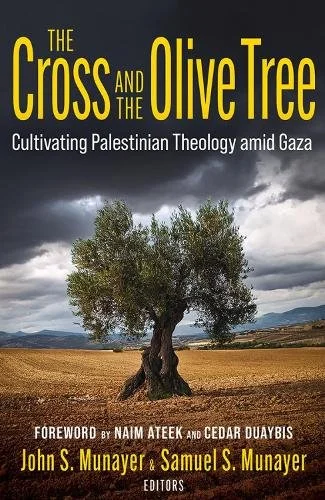
by John S. Munayer and Samuel S. Munayer
Reviewed by Kathy Shaw, Project Manager at SPARK Social Justice. Working in the voluntary sector for the last forty years, Kathy is enjoying combining her passion for social justice in a faith-based organisation.
The Cross and the Olive Tree is a slim volume, which boldly tackles the armed conflict in Gaza through a collection of 8 essays by young Palestinian Christians. These reflect on themes of identity, resistance and solidarity and how this shapes Palestinian liberation theology. A perceptive introduction from the editors Samuel Munayer and his brother John describe a spirituality that transcends the self and is rooted in community, a ‘communal covenant’, connected to the land and to God. The theology offered by the writers deliberately moves away from the academic, using language and insight to expose Western Christians to Palestinian heritage and voices. Their final chapter places martyrdom at the heart of Palestinian theological reflection.
The deep Christian history in Gaza is described as a microcosm of the broader Palestinian struggle, calling us to recognise ‘how the biblical justification for forced displacement has uprooted their theological foundations’ and threatens the very survival of Christianity in these territories. Overall, these essays challenge Western concepts of reconciliation and Palestinian ideals of uncompromising justice. The book is inspired by other liberation theologies, acknowledging the uncomfortable truths of white supremacy and how postcolonial Christian theology must return to scripture if it is to stand in solidarity with the oppressed. Perhaps the question this poses is whether people of faith have moral duties beyond the tradition of speaking truth to power, especially when it is evident that those in power know the truth, but choose to ignore it.
For me, the chapters written from a feminist and womanist tradition particularly resonate. The stories of grandmothers, teitas in Arabic, introduced storytellers carrying their oral history of faith and family values. Teitas faith rejects passivity, describing ‘faith that inspires action and action that is fuelled by faith’. Marah Sarji looks at the interconnections of gendered and sexual violence reported in places of displacement, aid centres and in conflict zones. In Palestine, silence is exacerbated by a patriarchal culture and the legal impunity given to perpetrators. As a result, women’s testimonies are rarely communicated in public, but in private they reflect a deep awareness of their vulnerability. Lamma Mansour writes in the final months of 2024, when the scale of destruction in Gaza is beyond comprehension. Using imagination to reclaim a vision of the possible, she asks, ‘In a Christ centred imagination, how would the Lord’s Prayer “Your kingdom come, your will be done” materialise in the context of Israel-Palestine.’ From this perspective, the author highlights the humanising capacity of imagination as a catalyst for change.
There is space for further insights on the failures of theology in the face of the war on Gaza, and the implications for the research of religion in general from a postcolonial perspective. This is particularly relevant when the current peace proposals potentially offer a continuation of Western colonial practices through indirect means.
These testimonies from diverse perspectives compel the reader to be engaged and see theology as a transformative force, rather than an abstract or academic concept. We are asked to find hope in Christ’s victory over injustice; ‘resurrection, love and compassion are more enduring than injustice and bigotry’. If we are to believe that peace and reconciliation are achievable, then the final message of The Cross and the Olive Tree is one of connection; ‘their witness will endure, a courageous declaration that life, truth and liberation triumph even in the shadow of death.’