
Beyond the “Quiet Revival”

Masculinity, Belonging, and the Search for Meaning
Tracy is a volunteer safeguarding and welfare officer at Chapeltown Juniors FC, working with young people and challenging discrimination. After a career in marketing and property, she now focuses on her studies, volunteering, and social justice. A mum of three, she returned to university at 48 and is studying for an MA in Religion, with sponsorship from Leeds Church institute. Her interests shaped by her own experiences of resilience and faith.
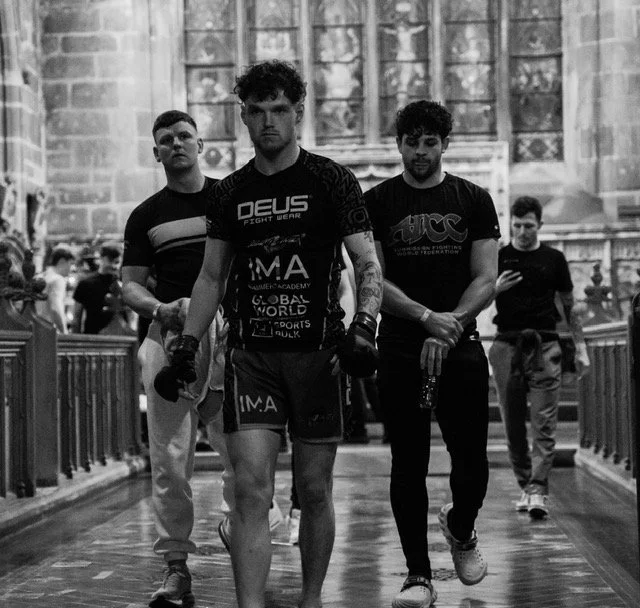
On 1st March this year, 26-year-old Jake Boyd stood in front of his church community to be baptised. A football coach and mixed martial arts fighter, he does not necessarily fit the stereotype of someone searching for faith. Yet his words, shared afterwards, were simple and disarming: “Christianity isn’t about becoming perfect. It’s about becoming new. God works from the inside out, and baptism is the outward declaration of that inward change.”
Jake’s story is not an isolated one. In recent months, headlines have suggested that something unexpected may be happening in Britain’s churches. Reports of a so-called “Quiet Revival” have pointed to a rise in attendance among younger generations, with particular attention given to young men. For churches long accustomed to narratives of decline, the idea that Gen Z — and especially young men — might be returning to faith has been both surprising and hopeful.

Yet the picture is far from straightforward. The “Quiet Revival” narrative has come under increasing scrutiny following concerns about the reliability of the data on which it was based. The Bible Society (2026), which published the original 2024 report, acknowledged that the survey sample was flawed and could no longer be treated as a reliable indicator of religious change.
At one level, this might seem like the end of the story. If the data is unreliable, then perhaps the “revival” itself is simply not happening. But that conclusion feels too neat. Because even as the statistics are questioned, the conversation has not gone away. If anything, it has intensified. The idea that young men are turning — or returning — to Christianity continues to circulate, raising deeper questions about why this narrative has taken hold at this particular moment.
Perhaps, then, the more interesting question is not simply whether a revival is happening, but why we are so ready to believe that it might be. What is it about this cultural moment that makes the image of young men rediscovering faith feel both plausible and compelling? And what might a story like Jake’s reveal that statistics alone cannot?
My own journey into these questions did not begin in a church, but on the sidelines of a football pitch. Years spent as a football mum—navigating evenings and weekends around training sessions, matches, and the rhythms of grassroots sport—immersed me in a world that, in many ways, mirrors religion. There is ritual, belonging, collective identity: singing in unison, shared joy, community, and hope. As others have noted, sport can function as a kind of “secular sacred space,” offering meaning and connection in ways that echo religious life.
But, like religion, this space was not uncomplicated. Alongside belonging existed exclusion: entrenched hierarchies, gendered expectations, and moments of overt misogyny. I encountered this firsthand. Speaking up from the sidelines—questioning a referee’s decision or challenging a coach—was frequently met with aggression. On one occasion, after a fellow mum called for a penalty, the referee responded: “Someone tell that woman to shut up, she doesn’t know what she’s talking about.”
Experiences like this prompted deeper questions. They led me to explore the relationship between masculinity, belonging, and identity through my undergraduate research, where I interviewed youth academy players on the cusp of leaving football.
What struck me was not bravado, but vulnerability. Beneath the performance of masculinity were young men searching for purpose, connection, and meaning beyond the pitch, as they began to lose the sense of belonging, identity, and community the game had given them. As one player told me, “Football’s probably the most beautiful game ever, because of the amount of joy it brings to everyone”.
It is from this vantage point that stories like Jake’s resonate. When I hear that young men may be finding their way into churches, it does not feel surprising. The question, for me, is not simply whether this is happening, but why spaces of belonging—whether football or church—continue to hold such power in shaping male identity
Jake’s journey offers one way into these questions. I first met Jake at Chapeltown Juniors FC, where I volunteer as a Club Welfare Officer, and he agreed to talk to me about his journey to Christianity and the role it has played in shaping his sense of identity. His path to faith did not begin with doctrine, but with experience: football, youth coaching, mental health struggles, and a search for belonging. He describes that he was not looking for religion as such, but for meaning — for something that could hold together identity, purpose, and community. His story suggests that even if the scale of a “revival” is uncertain, the conditions that make such a narrative believable are very real.

Questioning the “Quiet Revival”
However, framing this as a straightforward “revival” risk oversimplifying what is, in reality, a far more complex cultural moment.
Jake’s story does not begin with belief, but with crisis:
“I got to a really, really low point… and I just got on my knees, and I prayed. I said, ‘If there is something out there, please just help me.’”
This is not institutional religion drawing someone back. It is a lived experience pushing him to reach beyond himself.
His faith journey unfolded not through doctrine, but through a series of embodied experiences—mixed martial arts, friendships, mental health struggles, and moments he describes as “signs” or patterns that felt too significant to ignore. Faith, in this sense, emerges not as ideology, but as interpretation.
This complicates the idea of a “revival.” The Church, in Jake’s story, is not the starting point—it is the place he arrives once the search is already underway.
Masculinity, Identity, and the Search for Role
It is within this search that questions of masculinity begin to surface more clearly.
Reflecting on his own experience and the young men he coaches, Jake returns repeatedly to a sense of disorientation:
“I feel like a lot of men want to provide something… want something to give to… but they just don’t have any identity.”
What Jake is describing here is not simply about financial provision. It is about purpose.
The language of “providing” becomes a way of expressing a deeper desire: to contribute, to take responsibility, and to matter in relation to others. He links this to what he calls “masculine energy”—a drive to protect, support, and invest in something beyond the self.
Historically, these impulses were often channelled through clearly defined social roles—particularly within the family. But as Jake recognises, those structures have shifted:
“Women don’t necessarily need that anymore… and that’s not a bad thing.”
This is a crucial point. His concern is not women’s independence, but what follows it. If traditional roles are no longer required, what replaces them?
For Jake, the answer is uncertainty. The desire to give, to provide, to take responsibility remains—but without a clear framework, it becomes unanchored.
And it is precisely within this uncertainty that identity becomes contested.
“The church makes men feel more confident in what their true masculine values actually are.”
Here, Christianity functions not just as a belief but as validation. It affirms that traits such as responsibility, provision, and care are still meaningful—even if their expression is changing.
Yet this is where the tension sharpens.
Is this a genuinely new articulation of masculinity? Or a reassertion of older frameworks in a new context?
Scholars such as Stewart (2016) remind us that masculinity within early Christianity was far from rigid or uniform. Biblical models often centre on humility, vulnerability, and self-sacrifice—qualities that complicate contemporary appeals to strength or dominance.
Jake’s experience reflects both sides of this tension.
On one hand, his faith has enabled emotional openness and transformation:
“I’m so much more patient… I don’t act erratically anymore.”
On the other hand, it affirms a desire for clearer roles and structure:
“To provide… to protect.”
What emerges, then, is not a simple return to tradition, but a negotiation between vulnerability and structure, freedom and clarity, independence and belonging.
Beyond Revival: A Search for Belonging
What becomes clear is that the draw toward Christianity is not simply theological—it is relational and existential.
Jake describes the Church not as a place of judgement, but of belonging:
“You’re around good people… who share the same values and experiences.”
But belonging is never neutral. The spaces that offer it also shape the narratives we come to believe about ourselves—and about others.
The question, then, is not just why young men are finding the Church, but what they are finding within it.
Is it a space that expands their understanding of themselves? Or one that narrows it?
The idea of a “Quiet Revival” suggests something organic, even hopeful. But without critical engagement, it risks becoming a convenient narrative—one that overlooks the deeper cultural and gendered dynamics at play.
What I have found, both on the football pitch and in conversations like Jake’s, is not a simple return to faith.
It is a search.
For identity. For meaning. For belonging.
And perhaps most importantly, for a place where those things feel recognised—and real.

Extending the Critique: Cultural Influence and the Appeal of Certainty
To understand why this search is taking the shape it is, we also have to look beyond the Church—to the digital environments where identity is now being formed.
Jake is acutely aware of this landscape. When discussing figures such as Andrew Tate, his response is both reflective and revealing:
“He says a lot of things which are good… but a lot of things which are terrible… and it’s the terrible bits that young people are identifying with”
This tension is key.
Influencers like Tate do not gain traction simply through extremity, but through a mixture of discipline, self-improvement, and responsibility alongside more problematic messages about gender and power.
Jake explains how this plays out in practice:
“Some content I’ve viewed… 98% of it, I agreed with. But then someone else sends a completely different clip, with a very different message.”
What is being encountered is not a coherent worldview, but fragments—curated, amplified, and shaped by algorithmic systems.
“The algorithm will catch you… whatever you want to engage in… and give you more.”
In this environment, masculinity becomes something unstable, constructed through repetition, performance, and exposure rather than lived experience or community.
Jake captures the result succinctly:
“It becomes this kind of mess… no one really knows what anyone is saying.”
And it is precisely in response to this “mess” that the appeal of Christianity becomes clearer.
Where digital culture offers fragmentation, the Church offers coherence. Where algorithms amplify contradiction, it offers structure. Where identity feels unstable, it offers recognition.
But this raises a final, critical tension.
If young men are turning to Christianity in part as a response to confusion, then what kind of clarity is being offered in return?
Is it a space for reflection, growth, and complexity? Or an alternative form of certainty—one that risks simplifying identity in ways that mirror the very culture it stands against?
Beyond Revival
What, then, are we really witnessing?
The language of a “Quiet Revival” suggests a return—something lost being found again, a movement back toward belief.
Jake’s journey does not begin with certainty, nor does it end there. It begins in crisis, moves through experience, and finds shape in a community that offers both belonging and meaning. His faith is not simply inherited or adopted—it is assembled, piece by piece, through relationships, environments, and interpretation. In that sense, his story feels distinctly contemporary.
At the same time, his reflections expose a deeper cultural dynamic. The question of faith cannot be separated from the question of identity—particularly for young men navigating a world in which traditional roles have shifted, but no clear alternatives have fully taken their place. The desire “to provide,” to care, to take responsibility—these impulses have not disappeared. But without stable frameworks, they risk becoming untethered, vulnerable to both confusion and capture.
This is where the wider cultural landscape becomes impossible to ignore. In an age shaped by algorithmic feeds and influencer-driven narratives, identity is no longer formed slowly through community and tradition alone. It is mediated, accelerated, and often distorted. Figures like Andrew Tate do not create the desire for meaning or direction—but they do capitalise on it, offering clarity where there is uncertainty, even if that clarity is partial or problematic.
Against this backdrop, the Church can appear as a counter-space: a place of coherence in contrast to fragmentation, of belonging in contrast to isolation. For Jake, it provides not only faith, but recognition—a sense that his instincts toward responsibility, care, and purpose are not misplaced, but meaningful.
And yet, this is precisely where careful reflection is needed.
If the Church is becoming attractive because it offers clarity in a confusing world, it must ask what kind of clarity it is providing. Whether it is opening up space for growth, complexity, and mutual flourishing, or whether it risks reinforcing simplified narratives about gender, identity, and belonging under the language of tradition.
Because what is happening cannot be reduced to revival alone.
It is a negotiation. Between past and present. Between vulnerability and structure. Between freedom and the desire for direction.
Jake’s story does not offer a definitive answer—but it does offer an important insight. The young men often described as “returning” to faith are not simply going back. They are trying to move forward, carrying with them questions about who they are, what they are for, and where they belong.
Perhaps, then, the most honest way to understand this moment is not as a revival, but as a reconfiguration.
Not a quiet return to certainty, but an active search for meaning in a world where certainty is increasingly hard to find.
And if the Church is to play a role in that search, the challenge is not simply to welcome it—but to engage it with depth, honesty, and care.
Bible Society. 2026. Statement from Paul Williams, Chief Executive Officer, Bible Society. [Online]. [Accessed 22 April 2026]. Available from: https://www.biblesociety.org.uk/the-quiet-revival/statement-from-paul-williams
Stewart, E.C. 2016. Masculinity in the New Testament and Early Christianity. Biblical theology bulletin. 46(2), pp.91–102. Available from: https://journals.sagepub.com/doi/epub/10.1177/0146107916639211