
Blessed are the peacemakers

Alex Evans is executive director of Larger Us and author of The Good Apocalypse Guide on Substack.
‘Christian nationalism’ has arrived in the UK. Tommy Robinson’s ‘Unite the Kingdom’ march had lots of crosses on display and recited the Lord’s Prayer. Robinson himself claims to have been “led to Christ” in prison. The defection of Danny Kruger MP to Reform, meanwhile, will bring an overtly Christian tenor to a party that plans to deport the best part of a million people. All this raises big questions for Christians who feel deep unease about the increasing politicisation of our faith.
But there’s also a more hopeful story here. Because churches and the people who belong to them are uniquely well placed to respond not just to the emergence of Christian nationalism in the UK, but also, more broadly, to wider trends of populism and division.
Churches have a clear mandate to speak to issues of identity and conflict, after all, at a point when we urgently need storytellers who can help bring us together. They have vast reach: with nearly 5m members, they’re effectively the UK’s second largest membership body. They have on the ground presence all over the UK, including in places where tension is spiking. And they have an overriding concern for encounter, reconciliation, and welcoming the stranger — at a point when political division makes this more important than ever.
The them-and-us playbook
If you watch divisive leaders like Donald Trump, Nigel Farage, or Vladimir Putin, or extremist groups like the Proud Boys or the English Defence League, you soon notice that they all use the same ‘them-and-us’ playbook, which:
Feeds a sense of threat, taking us into fight-flight-freeze states in which we become more aggressive, less empathetic, more tribal, and less good at differentiating what’s real from what’s illusory (like fake news or conspiracy theories).
Preys on widespread feelings of disconnection and loneliness by offering a sense of belonging – but the kind of belonging but that’s based on who’s excluded from ‘us’, and that creates and amplifies division, othering and scapegoating.
Plays on feelings of shared loss (both locally, for instance about rundown town centres or the loss of local industries, or nationally, as with perceived loss of national prestige or status) as a source of grievance, rage, and identity.
Offers resonant stories, often combining an idealised past, a them-and-us conflict in the present, and a future of restoration and renewal through return to traditional values — with Christian nationalist mythology a key element.
This playbook has real psychological depth. It speaks to existential fears during a time of interlocking crises, to our need to belong and our tendency to retreat into in-groups when we feel threatened, and to the fact that we make sense of the world primarily through stories.
So how can we counter it?Try flipping it on its head. Imagine if more of us were able to:
Steady ourselves in the face of things we find threatening, so that we can make conscious choices about how to respond rather than lurching automatically into fight-flight-freeze.
Feel like we belong and are valued in spite of our shortcomings, resist scapegoating by recognising what we share in spite of the things that make us different, and bridge divides through the power of curiosity and encounter.
Grieve for experiences of shared loss rather than seeing them as a source of grievance, and find agency, purpose, and hope amid the loss.
Share deep stories of who we are, where we are and where we’re going, that help us expand how far our compassion extends and lean into connection, hope, and joy.
Across all four of these areas, churches and church groups have a potentially vital role.
Steadying ourselves
Tending to our mental and emotional states can seem like a luxury at a point when it seems like everything’s on fire. It’s not. What goes on in our heads is the front line of polarisation and populism — and as we keep seeing, it’s the hard right who understand this best.
Being able to make conscious decisions about how to respond to things that make us feel anxious or scared is ground zero for building resilience in polarised times — resilience not only to overwhelm, burnout, and compassion fatigue, but also to scapegoating and othering.
This is a skill that can be learned. It’s routinely trained for in emergency responders, for example – essentially through meditation techniques. Want to know who’s been practising this skill longer than anyone in our society? Churches. From Celtic island monasteries in the 5th century, up to today.
Contemplative Christianity is a treasure trove of techniques for steadying ourselves, whether through formal approaches like centring prayer, or through creating spaces where people can fall silent together. It’s also clear that there’s huge appetite for it today, as seen for instance in the immense popularity of Christian contemplatives like Richard Rohr, Cynthia Bourgeault, or Thomas Keating.
Which makes it all the more puzzling that contemplative approaches can be quite hard to find on the ground, in parishes. But if churches decided to change that, then they’d be making a big contribution not only to our peace of mind, but also to the peace of our societies.
Building belonging, bridging divides
Churches are by definition supposed to be places where all of us are welcome in spite of our shortcomings, and where we’re invited to recognise that we have more in common than that which divides us — both factors that matter more than ever amid our so-called culture wars.
And their emphasis on encounter, reconciliation and peacebuilding also makes them uniquely well placed to do the work of building bridges to people who are at risk of drifting towards the hard right, and using curious conversations to subvert and defuse the scapegoating dynamics that can draw people into extremism.
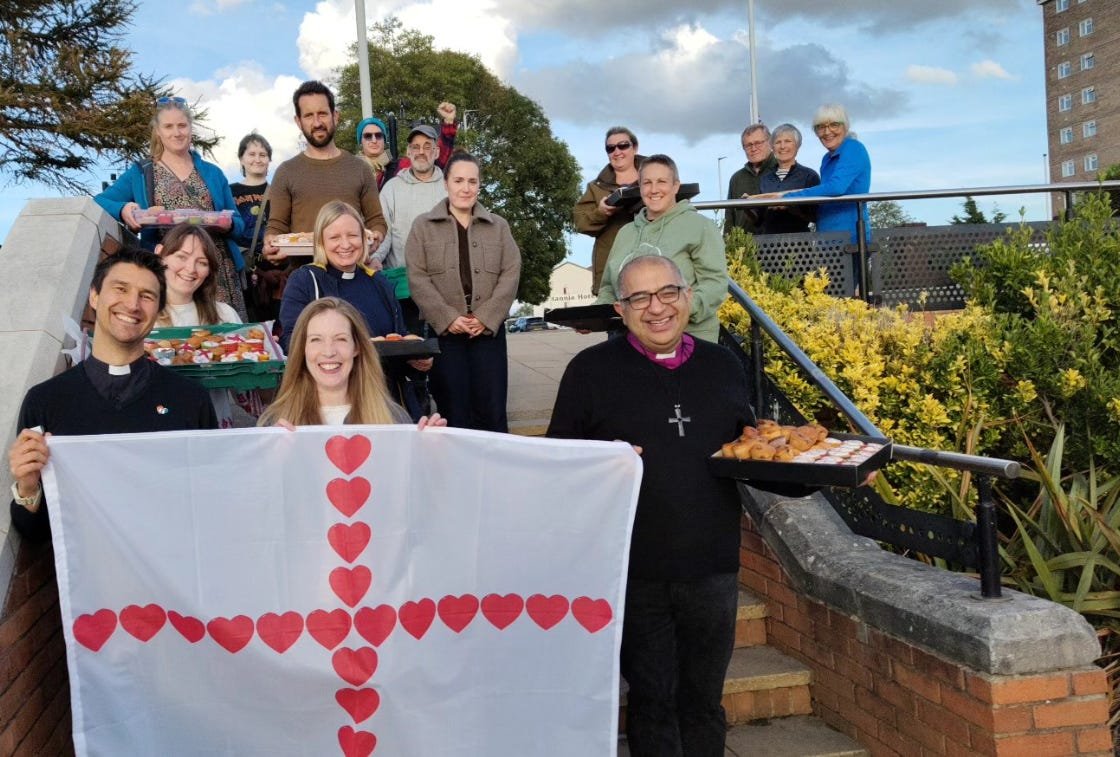
Bishop Arun, church leaders, and Christians in Leeds offer cakes to protestors in Seacroft
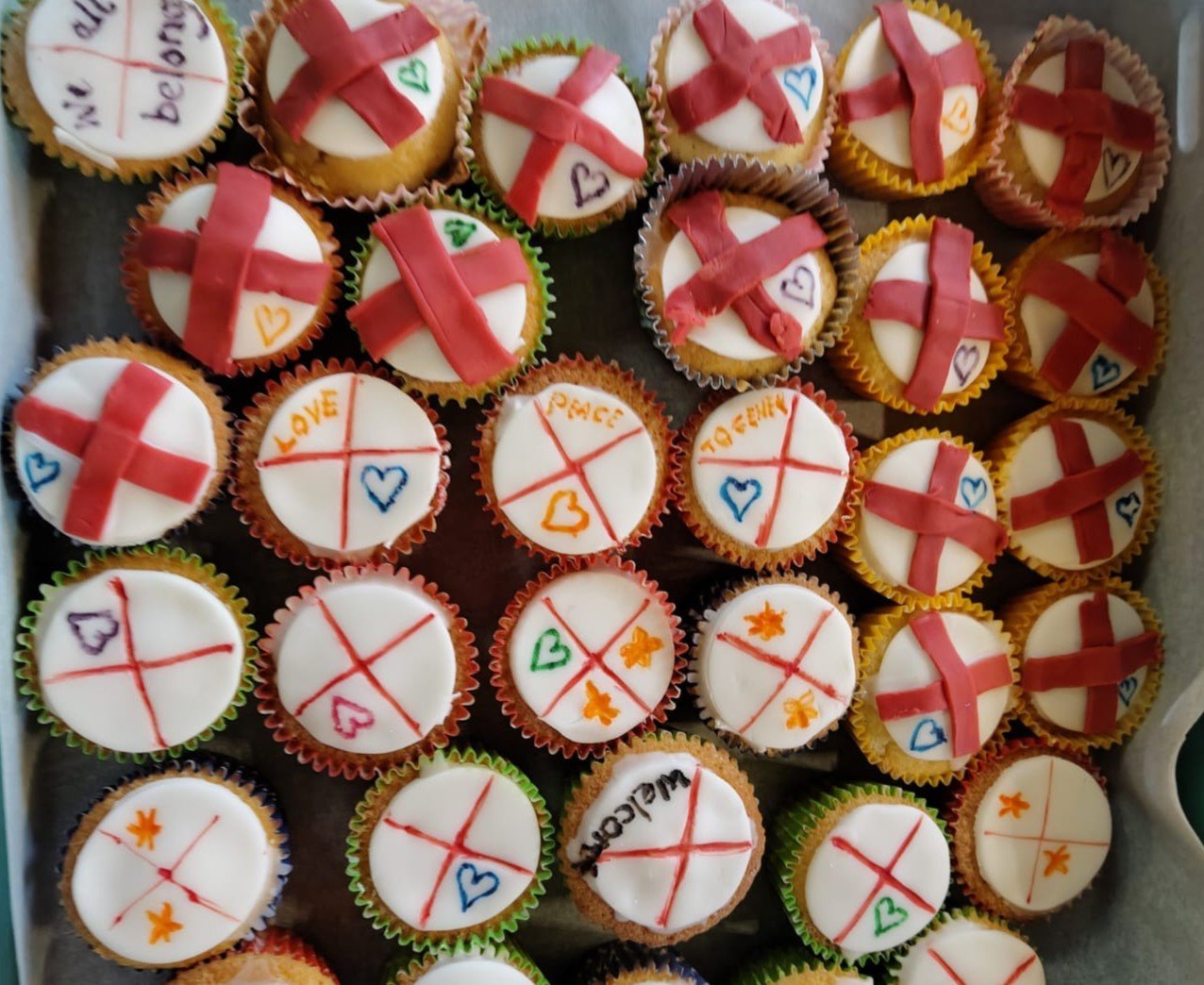
This is exactly what’s been happening in the Seacroft area of Leeds, where a hotel housing asylum seekers has become the site of weekly protests and counter-protests. People from local churches, with leaders including Revd Anne Russell, Revd Heston Groenewald, and Bishop Arun Arora, have started showing up with cake to talk to people on both sides – to make them feel heard, and help to dial down the temperature and build empathy.
By staying in relationship with everyone and refusing to ‘other’ anyone, they’re doing something subversive, transformational and wholly in line with Christian teachings: which is trying to end culture wars rather than win them.
It’s politically vital and spiritually inspiring work, and an approach that has the potential to be replicated much more widely.
Grieving shared loss
Experiences of shared loss can easily become the basis of tribal group identity, especially when manipulated by political leaders who excel at funnelling people along the ‘grief to grievance pipeline’: just look at Donald Trump’s narrative of ‘Make America Great Again’.
Psychiatrist and conflict mediator Vamik Volkan argues that the way to prevent this is through collective mourning for shared loss, whether in communities (dying industries, closed down high streets, the effects of drugs and crime) or whole nations (as when people feel a deep sense of national decline or loss of status).
Few political or civil society leaders are willing or able to talk about grief. But when space is made for grief, it can be extraordinarily powerful. And churches are well placed to do this kind of work, if they want to.
They have profound experience of lamentation — the Bible includes a Book of Lamentations, after all — and as the Old Testament scholar Walter Brueggemann observed, lament is, along with confronting reality and maintaining hope for the future, one of three essential prophetic tasks during times of crisis and upheaval.
Sharing deep stories
Finally, what about churches’ role in providing deep stories that can help us to find our way during times of crisis and upheaval?
Part of the reason the hard right has been able to flourish is our contemporary lack of deep shared stories, which has left the way open for extremists to fill the void with darkly resonant narratives of them-and-us.
But churches are well placed to do something about this.
To start with, they have a key role in contesting Christian nationalism. The open letter by church leaders earlier this year (Rowan Williams, numerous Church of England bishops, and senior Catholic, Methodist, Baptist, and Evangelical leaders), which criticised the “misuse” of Christian symbols at the Unite the Kingdom march, is a great start — especially its clear statement that:
The cross is the ultimate sign of sacrifice for the other. Jesus calls us to love both our neighbours and our enemies and to welcome the stranger. Any co-opting or corrupting of the Christian faith to exclude others is unacceptable.
Christian theology also has much to say about all of the themes explored above — steadying ourselves, bridging divides, grieving loss. Above all, there’s the explicit emphasis on welcoming and loving the stranger, above all in the story of the Good Samaritan — a parable that Pope Francis drew on to correct JD Vance’s invocation of the theological idea of ‘Ordo Amoris’ as an argument against welcoming refugees.
In England’s green and pleasant land
Church groups have much to contribute right now, whether on helping us to steady ourselves, encouraging us to bridge divides, supporting us as we grieve shared loss, or offering deep stories. In some areas, above all contesting the Christian nationalists’ interpretation of theology, they may be the only ones that can do it.
There are already bright spots, like the uplifting bridge building work taking place in Leeds. But there’s also so much more that churches all over the country could do. It’s a big moment for us. I hope we step up.